
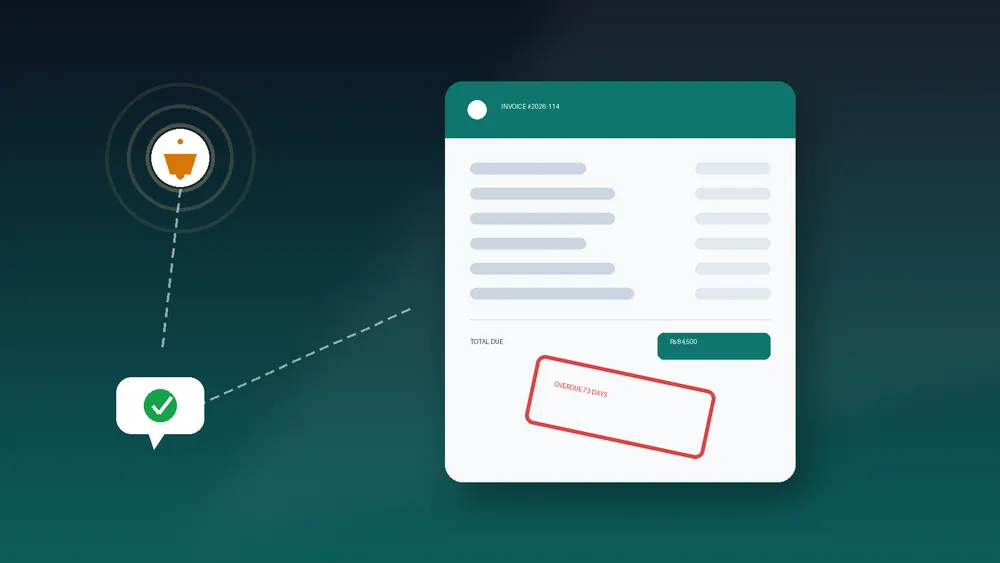
How do you automate payment collection?
You connect your accounting or ERP system to a rules engine that watches invoice due dates, then fires a scheduled sequence of reminders — WhatsApp, email, SMS — before and after the due date, escalates invoices that stay unpaid past a threshold to a phone call or notice, and writes payment status back into your ledger automatically. No one has to remember which customer owes what, or manually type out the same "payment pending" message for the fifth time this month. The automation runs on a schedule; a person only steps in when an account needs a judgment call.
Why Indian SMEs are stuck chasing payments
This isn't a paperwork problem — it's a cash flow problem with numbers behind it. The Indian SME Receivables Report 2026, which analyzed data from roughly 1.1 lakh MSMEs and over a million transactions, found that the average SME takes 73 days to collect an invoice — well past the 45-day payment window mandated for micro and small enterprises. The same report found the average SME is sitting on ₹3.83 crore in receivables pending for more than 360 days.
What makes this worse is that it isn't a credit-terms problem. 82.6% of invoices in the report were issued with credit periods of zero to 30 days. Buyers aren't taking long because SMEs offered long terms — they're taking long because nobody is consistently following up. When collections depends on a person remembering to send a WhatsApp message or make a call, it falls apart the moment that person is busy, on leave, or juggling twenty other accounts.
What automated collections actually looks like
A working setup has three moving parts:
Reminder cascade. The system checks due dates daily against your accounting or ERP data (Tally, Zoho Books, Busy, or a custom ledger) and sends a reminder 3 days before the due date, on the due date, and at 7, 15, and 30 days overdue — over WhatsApp Business API, email, or SMS depending on what the customer actually responds to.
Escalation rules. Past a threshold you set — commonly 30 or 45 days — the system flags the account for a human: a phone call from your accounts team, a formal notice referencing the MSME 45-day payment rule, or a hold on new orders until the balance clears.
Reconciliation. When a payment comes in via UPI, NEFT, or a payment gateway, it's matched against the open invoice automatically and the ledger updates without someone manually closing out the entry in a spreadsheet.
None of this requires a large software build. It's a workflow — due-date triggers, message templates, and an API connection between your accounting system and a messaging channel — which is exactly the kind of process Firstly Solutions builds for SMEs that don't want to buy and configure a heavyweight AR platform just to send reminders on schedule.
Example: a Kolkata industrial supplies distributor
A mid-sized industrial supplies distributor in Kolkata was carrying roughly ₹1.2 crore in receivables older than 60 days. Their process was a shared spreadsheet: someone on the accounts team was supposed to check due dates weekly and call customers who were behind. In practice, the sheet went stale for weeks at a stretch whenever that person was pulled into month-end closing or on leave.
After automating the reminder cascade against their existing Tally data — WhatsApp nudges at 3 days before due, on the due date, and at 7 and 15 days overdue, with a call-list auto-generated for anything past 30 days — the same team went from reactive, ad hoc follow-up to a system that ran itself. Overdue balances past 60 days dropped by roughly 40% within a quarter, not because anyone worked harder, but because no invoice could silently age past 15 days without a reminder going out.
Build vs. buy: off-the-shelf AR tools vs. a custom workflow
Off-the-shelf accounts receivable tools (several are built into Indian invoicing apps) work fine if your entire process fits inside one app and one payment flow. Where they fall short is when a business runs on Tally for accounting, WhatsApp for customer communication, and a separate portal for dealer orders — three systems that a generic AR tool won't touch. A custom workflow automation connects the systems you already use through their APIs, so the reminder cascade pulls real due dates from your existing ledger instead of asking you to re-enter every invoice into a new tool.
FAQ
How long does it take to set up automated payment reminders?
For a business already using a standard accounting system like Tally or Zoho Books, a working reminder cascade (WhatsApp/email/SMS, tied to real due dates) typically takes two to four weeks to design, connect, and test.
Will automated reminders annoy customers who are usually reliable payers?
No — the cascade is timed and worded differently by stage. A reminder sent 3 days before the due date reads as a courtesy notice, not a collections call. Escalation language only kicks in once an account is genuinely overdue.
Does this replace my accounts team?
No. It removes the manual, repetitive part — checking due dates and typing reminders — so your team spends its time on the accounts that actually need a phone call or a negotiation, not on the ones that just needed a nudge.
What if my customers pay through multiple channels — UPI, NEFT, cheque?
The reconciliation step is built to match against however payments actually arrive. Bank feed and payment gateway integrations handle UPI/NEFT automatically; cheque and cash payments can be logged manually with a single entry that still closes out the invoice in the system.
Is this compliant with the MSME 45-day payment rule?
Automating your own collections doesn't change what the law requires from your buyers, but it does give you a clean, timestamped record of every reminder sent — useful if a payment dispute ever needs to reference how overdue an invoice actually was.
Ready to stop chasing payments manually? Talk to Firstly Solutions about workflow automation and see what a reminder-to-reconciliation pipeline would look like for your ledger.